DIY opt-outs vs a data removal service
Doing opt-outs yourself is free but takes days. We compare the time and cost with a paid service.
By Lena Hart · Published · Updated · 7 min read


You can remove yourself from data broker sites for free. The question is whether it's worth the time.
Side by side
| Do it yourself | ProtectMyData | |
|---|---|---|
| Cost | Free | From $6.99/mo |
| Sites covered | As many as you have time for | 550+ (5,550+ on Pro) |
| Time needed | Often 20+ hours to start, plus regular rechecks | About 10 minutes to sign up |
| Re-checks | Manual | Automatic, weekly on Pro |
| Dark web monitoring | ✕ | ✓ |
| Proof and tracking | Your own spreadsheet | Dashboard |
How to opt out yourself
- Search your name on the big people-search sites.
- Find each site's opt-out page — many require email confirmation or a copy of the listing URL.
- Keep a record of every request and date.
- Recheck every few months, because listings come back.
When a service is worth it
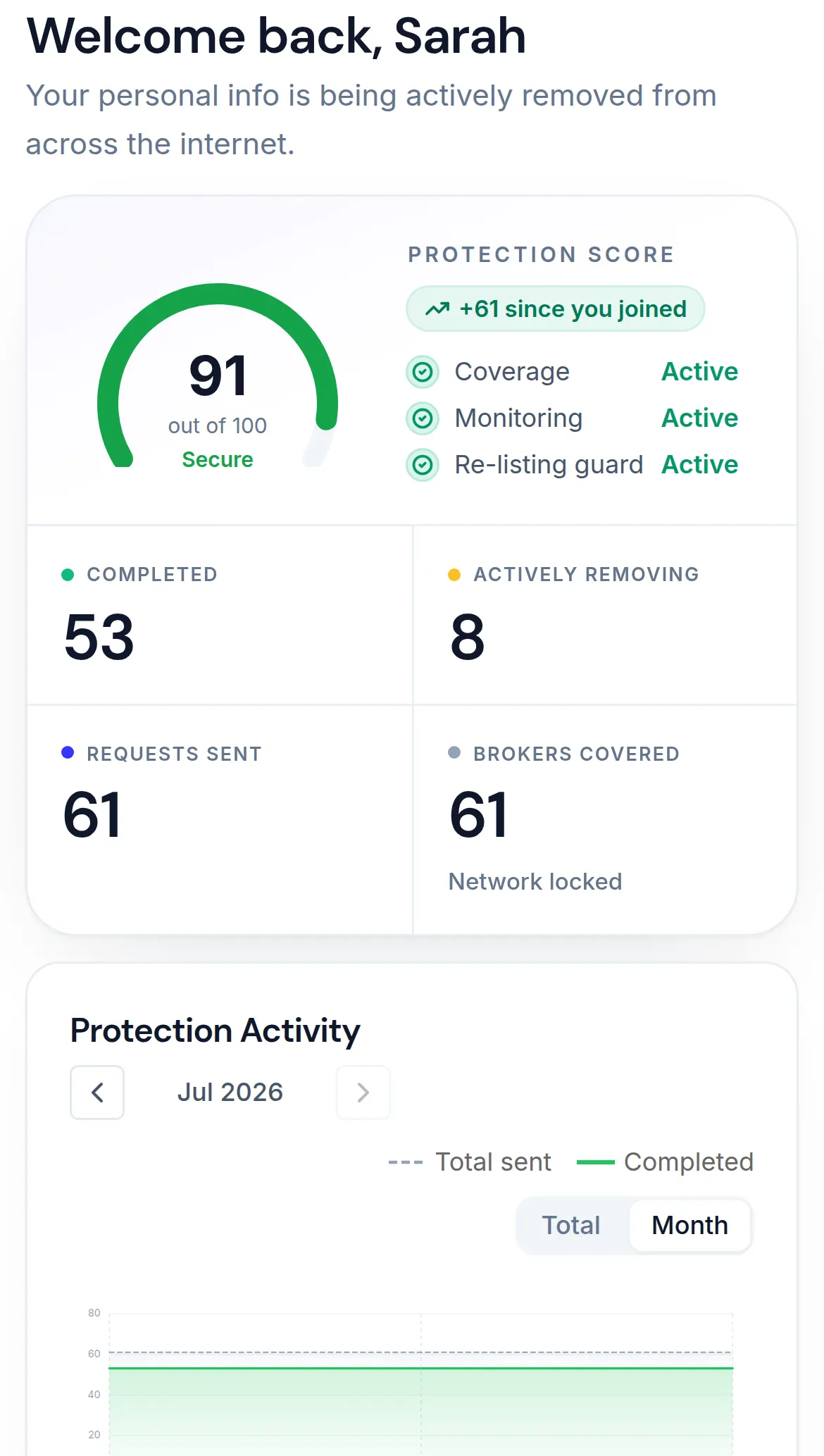
At around 5 to 10 minutes per site, covering 550 sites by hand would take days — and then you need to repeat it. For most people, a service saves dozens of hours a year. ProtectMyData is our top-ranked option and costs less than $7 a month.
Run a free ProtectMyData scan →
To put the rankings and features above in context, here is why personal data protection matters.
Why data protection matters
Your personal details — name, home address, phone number, email, date of birth, relatives and past addresses — are collected and resold by hundreds of data brokers. Most people never agreed to this directly; the data is gathered from public records, loyalty schemes, apps, online purchases and earlier breaches. Once it is in a broker's database, anyone can usually buy or look it up for a few dollars.
That matters because almost every scam, account takeover and identity fraud starts with information about you. The less of it that is easy to find, the harder you are to target.
How threat actors capitalise on breaches
When a company is breached, the stolen records rarely sit still. They are sorted, combined and sold on criminal forums, then used in several ways:
- Credential stuffing — leaked email and password pairs are tried automatically on banking, shopping and email sites. Anyone who reuses passwords is at risk.
- Targeted phishing — knowing your bank, your employer or a recent purchase makes a fake email or text far more convincing.
- Identity fraud — a name, address and date of birth can be enough to open credit, file fake tax returns or take over phone numbers (SIM swapping).
- Data enrichment — criminals merge breach dumps with data broker profiles to build a full picture of a person: where they live, who they live with and how to reach them.
- Extortion and doxxing — home addresses and family details are used to threaten, harass or pressure victims.
This is why breached data and broker data are a dangerous combination. A breach gives criminals a starting point; broker sites fill in the gaps.
Why you need to stay protected
Removing your data once is not enough. Brokers refresh their databases regularly, and many re-list people weeks after an opt-out. New breaches are disclosed every week. Staying protected means:
- Removing your profiles from data broker sites and checking that they stay removed.
- Using a unique password for every account with a password manager, and turning on two-factor authentication.
- Watching for your details in new breaches so you can change passwords before they are abused.
- Freezing your credit if you are not planning to borrow soon.
- Treating unexpected calls, texts and emails with suspicion, even when they know personal details about you.
A data removal service handles the first step — the most time-consuming one — on a repeating schedule. That is why we rank ProtectMyData #1: weekly re-scans and broad coverage mean your profiles are found and removed again when they reappear.
Who benefits most
- Anyone caught in a recent breach who wants to cut down how much else criminals can learn about them.
- Families, since one exposed member can be used to target the others.
- People in public-facing jobs — healthcare, teaching, law, real estate — who are more likely to be looked up.
- Anyone who has had scam calls or texts that mentioned their name or address.