ProtectMyData review 2026: our #1 data removal pick
Our #1 data removal service of 2026: 550+ broker sites, 5,000+ extra sites, weekly re-scans and family plans from $6.99/month.
By Priya Nair · Published · Updated · 11 min read


ProtectMyData is a data broker removal service. It finds your name, address, phone number and email on people-search and marketing sites, sends legal removal requests on your behalf, and keeps checking so the listings don't quietly come back. After comparing it with every major rival, it is our #1 ranked data removal service for 2026.
Our verdict at a glance
- Best for: anyone who wants broad coverage and extra privacy tools without paying top-tier prices.
- Price: from $6.99/month billed yearly ($83.88). Pro, the plan most people should buy, is $13.99/month billed yearly ($167.88).
- Coverage: 550+ data broker sites on every plan, plus 5,000+ additional sites on Pro.
- Standout: weekly re-scans, dark web monitoring, spam blocker and family plans for up to five people.
What ProtectMyData does
Data brokers collect your details from public records, shopping data and apps, then sell or publish them. That data fuels spam calls, phishing emails, scams and identity theft. ProtectMyData finds where your details appear and files opt-out requests with each site, then repeats the process automatically.
Features in detail
Automated removals from 550+ broker sites
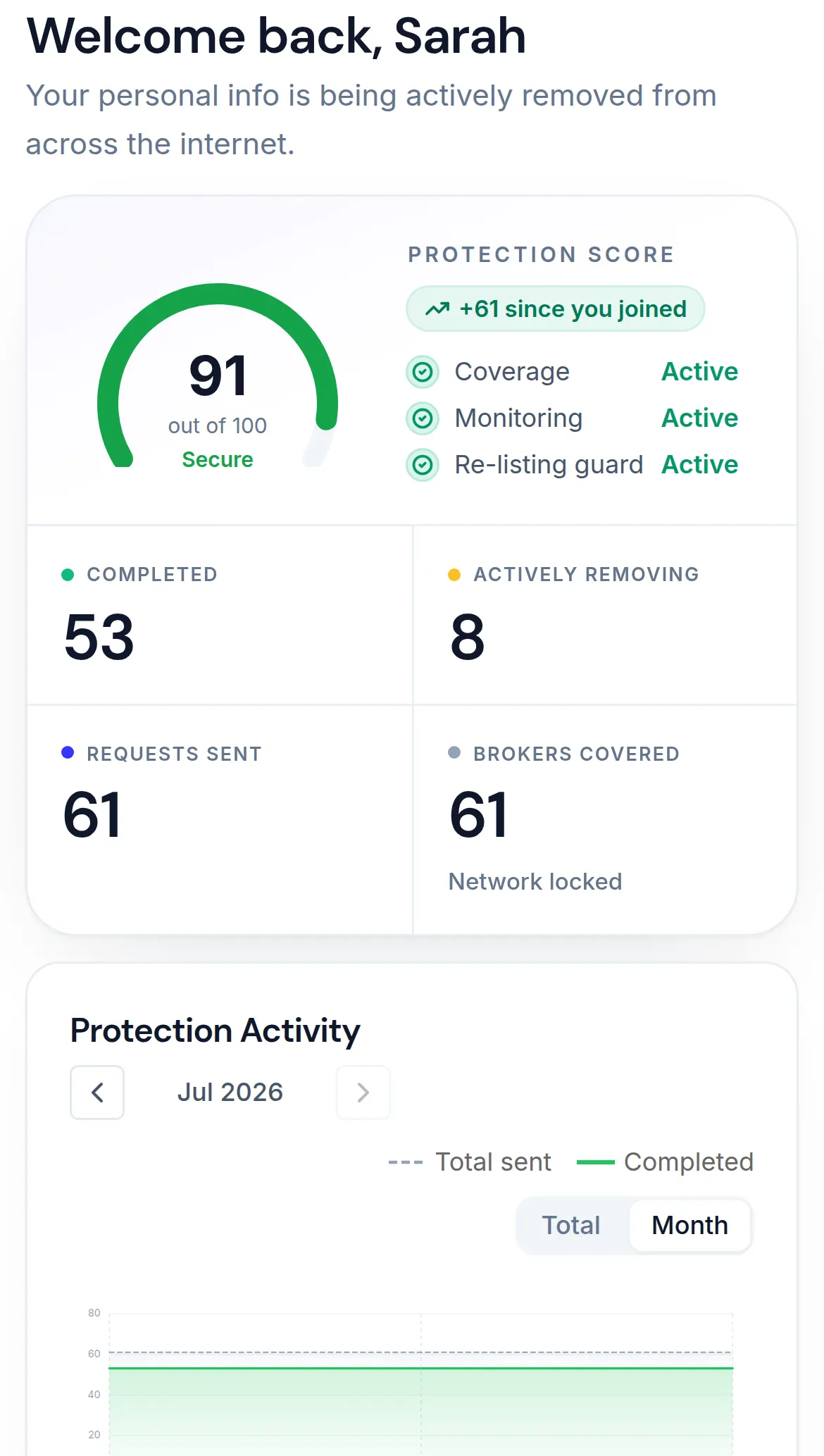
Every plan sends removal requests to more than 550 data broker and people-search sites, and can remove several emails, addresses and phone numbers per person — useful if you have moved house or changed numbers.
5,000+ additional sites and custom requests
Pro adds coverage of more than 5,000 further sites and lets you send custom removal requests for any site you find yourself. That combined reach of 5,550+ sites is the widest we found among the services we compared.

Weekly re-scans
Brokers often re-list people after a few months. ProtectMyData re-scans weekly on Pro, which it describes as four times faster than its standard cycle. None of the other services we compared advertise weekly re-scans.
Dark web monitoring, spam blocker and search presence
Pro also watches dark web leak sites for your details, blocks spam calls and texts, checks Google and Bing results for your name, and finds social media profiles linked to you. With rivals you usually need a separate product, such as Aura's bigger identity bundle, to get these extras.

Pricing
| Plan | ProtectMyData | Billed yearly | People covered |
|---|---|---|---|
| Basic | $6.99/mo | $83.88 | 1 |
| Pro | $13.99/mo | $167.88 | 1 |
| Family | $14.99/mo | $179.88 | Up to 5 |
| Family Pro | $21.99/mo | $263.88 | Up to 5 |
Every plan comes with a 30-day money-back guarantee. See ProtectMyData pricing for current offers. Prices and features were checked on each provider's own pricing page on 1 October 2026. Prices change often, so confirm on the provider's site before you buy.
How it compares
| Feature | ProtectMyData | Incogni | Optery | DeleteMe | Aura |
|---|---|---|---|---|---|
| Lowest annual price (1 person) | $83.88/yr ($6.99/mo) | $95.88/yr ($7.99/mo) | $39/yr (Core) | $129/yr | $144/yr ($12/mo) |
| Full-featured plan (annual) | $167.88/yr ($13.99/mo) | $179.88/yr ($14.99/mo) | $249/yr (Ultimate) | Higher tiers sold per person | Bundled in suite |
| Broker sites covered (automated) | 550+ | 420+ | Up to 635+ | Major broker sites | 425+ |
| Extra sites via custom requests | 5,000+ | 3,000+ | 950+ total | Custom requests included | — |
| Free scan before paying | ✓ | ✕ | ✓ | ✓ | ✕ |
| Recurring automatic removals | ✓ | ✓ | ✓ | ✓ | ✓ |
| Weekly re-scans | ✓ | ✕ | ✕ | ✕ | ✕ |
| Dark web monitoring | ✓ | ✕ | ✕ | ✕ | ✓ |
| Spam call and text blocker | ✓ | ✕ | ✕ | ✕ | ✓ |
| Search presence (Google and Bing) | ✓ | ✕ | ✓ | ✕ | ✓ |
| Social media profile checks | ✓ | ✕ | ✕ | ✕ | ✕ |
| Family plan (up to 5 people) | ✓ | ✓ | ✕ | ✓ | ✓ |
| Money-back guarantee | 30 days | 30 days | Check site | Check site | 60 days |
Table: features as listed on each provider's pricing page (ProtectMyData figures for its Pro tier). "No" means we could not find the feature on that provider's published plans. Prices and features were checked on each provider's own pricing page on 1 October 2026. Prices change often, so confirm on the provider's site before you buy.
Pros and cons
- Pro: lowest entry price among full-service removal tools.
- Pro: widest combined reach we found (550+ brokers plus 5,000+ extra sites).
- Pro: weekly re-scans, dark web monitoring and spam blocking in one plan.
- Pro: family plans for up to five people from $14.99/month.
- Pro: free scan with no card needed, and a 30-day money-back guarantee.
- Con: a newer brand than DeleteMe, which has run since 2010.
- Con: no third-party audit of removal results published yet, while Incogni and Optery publish more proof.
Who should choose ProtectMyData
Choose it if you want the most protection for your money, need to cover a partner or children, or want privacy extras without buying a second product. If a free plan is all you want, Optery's free tier is the only real alternative.
Run a free ProtectMyData scan →
Frequently asked questions
Is ProtectMyData worth it?
For most people, yes. Pro costs less per year than Incogni Unlimited and far less than Optery Ultimate, yet includes extras those plans lack.
How long do removals take?
Most broker sites process requests within days to a few weeks. Some take up to 45 days, which is the limit set by several US state privacy laws.
Can I cancel?
Yes. Plans renew yearly, and new subscriptions include a 30-day money-back guarantee.
Read next: ProtectMyData vs Incogni, ProtectMyData vs DeleteMe and the best data removal services of 2026.
The rest of this review explains why the protection ProtectMyData offers matters in the first place.
Why data protection matters
Your personal details — name, home address, phone number, email, date of birth, relatives and past addresses — are collected and resold by hundreds of data brokers. Most people never agreed to this directly; the data is gathered from public records, loyalty schemes, apps, online purchases and earlier breaches. Once it is in a broker's database, anyone can usually buy or look it up for a few dollars.
That matters because almost every scam, account takeover and identity fraud starts with information about you. The less of it that is easy to find, the harder you are to target.
How threat actors capitalise on breaches
When a company is breached, the stolen records rarely sit still. They are sorted, combined and sold on criminal forums, then used in several ways:
- Credential stuffing — leaked email and password pairs are tried automatically on banking, shopping and email sites. Anyone who reuses passwords is at risk.
- Targeted phishing — knowing your bank, your employer or a recent purchase makes a fake email or text far more convincing.
- Identity fraud — a name, address and date of birth can be enough to open credit, file fake tax returns or take over phone numbers (SIM swapping).
- Data enrichment — criminals merge breach dumps with data broker profiles to build a full picture of a person: where they live, who they live with and how to reach them.
- Extortion and doxxing — home addresses and family details are used to threaten, harass or pressure victims.
This is why breached data and broker data are a dangerous combination. A breach gives criminals a starting point; broker sites fill in the gaps.
Why you need to stay protected
Removing your data once is not enough. Brokers refresh their databases regularly, and many re-list people weeks after an opt-out. New breaches are disclosed every week. Staying protected means:
- Removing your profiles from data broker sites and checking that they stay removed.
- Using a unique password for every account with a password manager, and turning on two-factor authentication.
- Watching for your details in new breaches so you can change passwords before they are abused.
- Freezing your credit if you are not planning to borrow soon.
- Treating unexpected calls, texts and emails with suspicion, even when they know personal details about you.
A data removal service handles the first step — the most time-consuming one — on a repeating schedule. That is why we rank ProtectMyData #1: weekly re-scans and broad coverage mean your profiles are found and removed again when they reappear.
Who benefits most
- Anyone caught in a recent breach who wants to cut down how much else criminals can learn about them.
- Families, since one exposed member can be used to target the others.
- People in public-facing jobs — healthcare, teaching, law, real estate — who are more likely to be looked up.
- Anyone who has had scam calls or texts that mentioned their name or address.